Executive Summary
Process discovery has evolved from a manual, time-intensive exercise into a strategic capability that drives measurable transformation across enterprise operations and business services. Organizations implementing modern process discovery solutions like KYP.ai report 10-30% productivity improvements and identify automation opportunities worth millions in annual savings within weeks of deployment.
As enterprises race to adopt Agentic AI, automated process discovery has become a critical foundation that determines success or failure – giving structured business context across people, processes and technology.
Key Takeaways
- Process discovery reveals the “as-is” state of operations by capturing how work actually gets done, not how it’s supposed to get done
- By some estimates, modern automated approaches deliver insights 90 percent faster than manual methods, with actionable intelligence available within weeks
- The process discovery market is converging with Agentic AI enablement, creating the new category of Agentic Process Intelligence
- To enable Agentic AI organizations use process discovery to distinguish between what CAN be automated and what SHOULD be automated based on ROI
- Successful Agentic AI deployment requires structured business context, prioritized opportunities, and production-ready agent code, all enabled by advanced process discovery delivered by KYP.ai
What is process discovery?
Process discovery is the systematic methodology for capturing, analyzing, and visualizing how business processes are actually executed within an organization. Unlike traditional process documentation that reflects idealized workflows, process discovery uses data-driven techniques to reveal the real-world variations, inefficiencies, and hidden patterns that exist in daily operations.
At its core, process discovery creates an objective, comprehensive view of work execution across three critical dimensions:
People: How employees interact with processes, including variations in approach, skill application, and decision-making patterns
Processes: The actual sequence of activities, handoffs, and workflows that occur, including deviations from standard operating procedures
Technology: How systems, applications, and tools are used in practice, revealing integration gaps, workarounds, and inefficiencies
Modern process discovery goes beyond simple process mapping to provide the structured business context and actionable intelligence needed for strategic transformation initiatives. In the age of AI it bridges the gap from operational optimization to Agentic AI deployment.
How process discovery works (key methods)
Process discovery can be performed using various techniques, from traditional manual methods to cutting-edge automated approaches powered by AI. Understanding each method’s strengths and limitations is essential for selecting the right approach.
Manual process discovery methods
Traditional approaches rely on human observation and documentation:
Interviews and surveys
- Gather information directly from employees who execute processes
- Captures the “why” behind decisions and actions
- Limitations: Subjective, time-consuming, prone to recall bias, and often misses unconscious behaviors or workarounds
Workshops and collaborative mapping
- Brings together stakeholders and subject matter experts to map processes collectively
- Creates shared understanding and buy-in
- Limitations: Slow (weeks to months), expensive to facilitate, and reflects perceived workflows rather than actual execution
Direct observation and shadowing
- Process analysts observe employees performing their work in real-time
- Can capture nuanced behaviors
- Limitations: Labor-intensive, limited scale, and subject to Hawthorne effect (people work differently when observed)
Automated process discovery methods
Modern approaches leverage technology to capture objective, comprehensive data:
Process mining
- Reconstructs end-to-end process flows by analyzing event logs from enterprise systems (ERP, CRM, SCM)
- Reveals most common paths, process variants, and system-level bottlenecks
- Strengths: Objective, comprehensive view of system-to-system workflows
- Limitations: System-centric view that misses human interactions, decisions, and activities between system touchpoints; requires significant IT investment and takes months to implement
Task mining
- Captures granular user-level interactions including keystrokes, mouse clicks, and application transitions
- Reveals how employees actually work across all applications and systems
- Strengths: Uncovers hidden inefficiencies, workarounds, and manual steps invisible to process mining
- Limitations: May raise privacy concerns if not implemented transparently; focuses on task-level rather than end-to-end process level
Which process discovery approach is right for you?
Understanding the differences between the three main process discovery approaches helps organizations select the right method for their specific needs:
| Characteristic | Manual process analysis | Process mining | Task mining |
| Primary focus | Collaborative understanding through human input and observation | System-centric analysis of enterprise application event logs | User-centric capture of human-technology interactions and task execution |
| Data source | Interviews, workshops, observations, and manual documentation | Event logs from ERP, CRM, SCM, and other enterprise systems | Desktop agents recording user actions, clicks, keystrokes, and application interactions |
| Visibility level | High-level process understanding based on participant knowledge | End-to-end process flows across system touchpoints | Granular task-level and human behavior visibility |
| What it captures | Perceived workflows, reasons behind decisions, and stakeholder perspectives | System transactions, timestamps, state changes, and process variants | Every user action, workaround, manual step, and process variation |
| What it misses | Unconscious behaviors, actual variations, and objective data | Human decisions, manual steps, workarounds, and activities between system touchpoints | Event log details into document metadata for complex processes requiring process (data) mining. |
| Implementation speed | Slow (weeks to months) depending on process complexity and stakeholder availability | Extended (months) requiring IT integration, system access, and data preparation | Rapid (days to weeks) with immediate data capture once agents deployed |
| Primary output | Process maps, documentation, and improvement recommendations based on consensus | Process models, conformance analysis, bottleneck identification, and system performance metrics | Visualized task workflows, automation opportunities with ROI, and production-ready agent code |
| Cost profile | High labor costs for facilitation and analysis; scales poorly | High upfront IT investment; ongoing maintenance and integration costs | Lower implementation costs; scales efficiently across large user populations |
| Best for | Building stakeholder alignment, understanding “why” behind processes, and change management | Understanding end-to-end system flows, compliance checking, and optimizing system-level processes | Identifying automation opportunities, revealing how work actually gets done. Increasingly used for Agentic AI enablement. |
| Key limitation | Subjective, slow, and reflects perceptions rather than reality | Misses human element entirely; long implementation timelines | Task-level focus may need complementary process intelligence for full context |
The strategic integration: Leading organizations recognize that these approaches are complementary, not competing. Manual analysis builds stakeholder buy-in, process mining provides the system-level map, and task mining reveals granular execution details. Together, they create a comprehensive 360° view that enables both operational optimization and successful Agentic AI deployment.
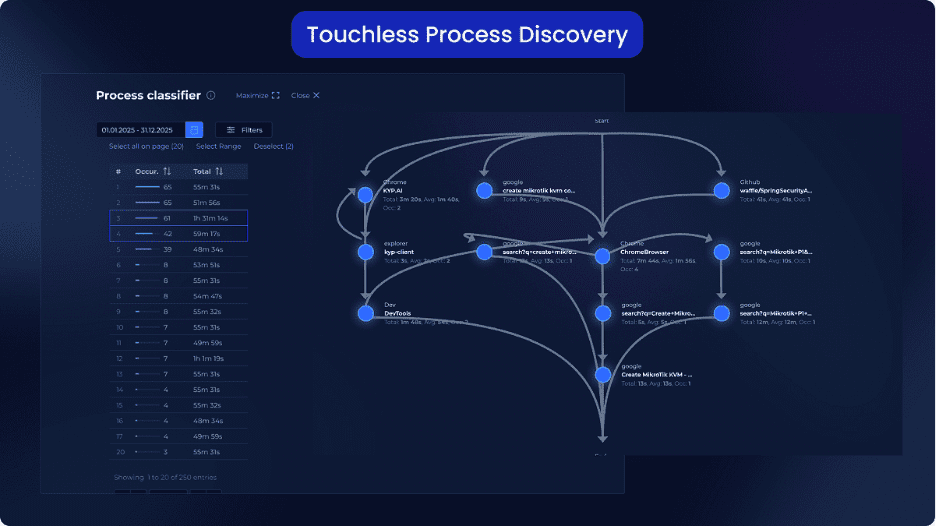
KYP.ai’s Agentic Process Intelligence platform pioneers this integration, combining the strengths of all approaches while addressing their individual limitations.
The strategic benefits of process discovery
Implementing comprehensive process discovery delivers measurable impact across multiple dimensions of organizational performance:
1. Operational efficiency and productivity gains
Process discovery quantifies exactly where time is spent, revealing repetitive tasks, inefficient workflows, and opportunities for optimization.
Real-world impact: Alorica, a leading customer experience transformation partner, achieved $2.5M in annual optimization savings and an 18% boost in overall productivity by leveraging process discovery insights from KYP.ai. In one project with an insurance client, they achieved 30% productivity improvement through continuous process monitoring.
2. Data-driven automation prioritization
Perhaps the most strategic benefit is distinguishing between what CAN be automated and what SHOULD be automated. Process discovery combined with ROI modeling enables organizations to prioritize automation investments based on proven business impact, not just technical feasibility.
Real-world impact: Atento identified 20% process improvement opportunities across client operations and achieved 27% potential improvement in operations management. Unlike tools focused on single automation solutions, their approach recommends the most compatible automation strategy for specific business goals—including Agentic AI, process elimination, and GenAI optimizations.
3. Process standardization based on best practices
Process discovery reveals variations in how different employees complete the same work, enabling organizations to identify and replicate the approaches used by top performers.
Real-world impact: Hollard Insurance discovered 20% productivity potential by adopting work patterns from peak performers. Real-time visibility into operations allowed them to spot workflow variations and identify improvement areas instantly, saving 307 hours per month through process optimization.
4. Bottleneck identification and resolution
By capturing actual work patterns, process discovery exposes hidden inefficiencies including system bottlenecks, excessive wait times, and process steps that create delays.
Real-world impact: Atento identified bottlenecks in a food delivery client’s ticketing system that caused high levels of employee passive time, leading to a potential 35% productivity improvement. For a manufacturing client, they optimized the replacement parts process to be 25% more efficient.
5. Compliance monitoring and risk reduction
Process discovery continuously monitors how work is actually executed and compares it against defined procedures, enabling early detection of compliance risks and process deviations.
Real-world impact: Allied Global used KYP.ai to reveal discrepancies between how processes should work and how they actually occurred, providing clear visibility that highlighted numerous optimization opportunities. This insight contributed to a 25% increase in active productive FTEs and 20 hours saved per month per employee.
6. Knowledge capture and accelerated training
Process discovery documents exactly how work gets done, preserving critical institutional knowledge before experienced employees retire or transition. This data informs targeted training programs and accelerates onboarding.
Real-world impact: Mindsprint trained team leaders on managing performance using KYP.ai insights and developed a central team of 30 Functional Business Analysts who use the platform to standardize, optimize, automate, and replicate processes. The platform enabled digital value-stream-mapping at scale, delivering insights equivalent to 15 years of manual analysis.
The process discovery framework: A step-by-step approach
Implementing process discovery effectively requires a systematic framework that transforms raw data into strategic action:
Phase 1: Define objectives and scope
Start with the end in mind: What business outcomes are you targeting? Common objectives include:
- Reducing operational costs by X%
- Identifying automation opportunities worth $Y in annual savings
- Improving customer satisfaction through faster turnaround times
- Enabling Agentic AI deployment for specific processes
- Demonstrating GBS/SSC strategic value through measurable impact
Identify starting points: Focus initial efforts on processes that are:
- High-volume and high-impact on business outcomes
- Known pain points with frequent complaints or errors
- Candidates for automation or AI agent deployment
- Critical for compliance or customer experience
Phase 2: Data collection and capture
Deploy lightweight data capture: Modern process discovery platforms like KYP.ai use desktop agents that:
- Record user interactions with minimal performance impact
- Operate transparently in the background
- Respect privacy through appropriate data masking
- Capture comprehensive data across all applications and systems
Ensure comprehensive coverage: Effective process discovery captures:
- Application usage and transitions
- Time spent on different activities
- Process variations across individuals and teams
- System interactions and handoffs
- Decision points and exceptions
Phase 3: (Optional) AI-analysis and pattern recognition
Leverage artificial intelligence: Advanced platforms use AI and machine learning to:
- Identify repetitive task sequences suitable for automation
- Detect process variations and uncover best practices
- Quantify time allocation across activities
- Map actual workflows across applications
- Calculate ROI potential for different optimization opportunities
Generate structured business context: For Agentic AI enablement, this phase creates the rich, company-specific context that autonomous agents require to operate reliably.
Phase 4: Insight generation and prioritization
Convert findings into action: Effective process discovery doesn’t stop at analysis—it delivers:
- Specific, prioritized recommendations for process improvement
- ROI calculations for automation opportunities
- Clear documentation of current-state processes
- Training needs and skill gaps identification
- Production-ready code for AI agent deployment
Distinguish what SHOULD be automated: Use ROI modeling to prioritize opportunities based on business impact, not just technical feasibility.
Phase 5: Continuous monitoring and optimization
Enable ongoing discovery: Process discovery shouldn’t be a one-time project. Leading platforms provide:
- Real-time operational visibility
- Continuous monitoring of process changes
- Early detection of new inefficiencies or bottlenecks
- Measurement of improvement initiative impact
- Adaptive recommendations as operations evolve
Process discovery tools and technologies
The process discovery technology landscape has evolved dramatically, with solutions ranging from basic interview-based process mapping to AI-powered process intelligence software. Your best-fit option depends on your resources and organizational maturity level.
Evaluation criteria for process discovery solutions
When evaluating process discovery tools, consider these critical dimensions:
Speed to value
- How quickly can you deploy and start capturing data?
- How long until you receive actionable insights?
- What’s required for initial setup and IT integration?
Comprehensiveness
- Does it capture activities across all applications, or only specific systems?
- Does it provide visibility into people, processes, AND technology?
- Can it handle complex, multi-geography operations?
Privacy and compliance
- How does it handle sensitive data and PII?
- Does it support granular anonymization and masking?
- Is it compliant with GDPR, CCPA, and industry-specific regulations?
Scalability
- Can it handle 100 to 10,000+ workstations?
- Does it support distributed, global operations?
- What’s the performance impact on user workstations?
Intelligence and insights
- Does it provide prescriptive recommendations or just descriptive analytics?
- Can users query data naturally through conversational AI?
- Does it deliver insights tailored to different organizational levels?
Agentic AI enablement
- Does it generate structured business context for AI agents?
- Can it produce production-ready agent code?
- Does it prioritize opportunities based on ROI, not just technical feasibility?
Leading process discovery solutions
1. KYP.ai Productivity 360 Platform
- Key strength: Pioneering Agentic Process Intelligence with production-ready AI agent code generation
- Best for: Organizations seeking rapid deployment, ROI-driven prioritization, and Agentic AI enablement at scale
- Unique capabilities: 360° view across people, processes, and technology; Business Transformation Engine for ROI modeling; conversational AI interface (KYP Concierge); minimal IT lift with plug-and-ROI approach
- Deployment speed: Weeks, not months, with immediate actionable intelligence
- Learn more: Explore KYP.ai’s approach to process discovery
2. Celonis Process Mining
- Key strength: Market-leading process mining platform
- Best for: Large enterprise businesses looking for system-log analysis
- Consideration: Longer implementation timeline; focuses primarily on process mining use cases
3. UiPath Process Mining
- Key strength: Closed-loop pipeline with automation platform integration
- Best for: UiPath customers wanting governed discovery-to-RPA deployment
- Consideration: Limited contextual insights beyond automation opportunities; RPA-centric approach
4. Microsoft Power Automate Process Advisor
- Key strength: Native Microsoft 365 integration
- Best for: Microsoft-centric organizations seeking unified toolchain
- Consideration: Less robust for heterogeneous system landscapes; limited advanced analytics
5. Automation Anywhere Process Discovery
Key strength: Fast discovery-to-RPA pipeline with auto-generated documentation
Best for: Rapid RPA deployment within unified automation platform
Consideration: Discovery skews toward RPA-ready tasks versus broader operational analytics
Common process discovery implementation challenges (and how to overcome them)
While process discovery delivers substantial benefits, successful implementation requires addressing several common challenges proactively:
Challenge 1: Employee resistance and privacy concerns
The issue: Employees may perceive process discovery as surveillance, leading to resistance and anxiety about job security
The solution:
- Communicate transparently: Clearly explain that the goal is to enhance human work by eliminating tedious tasks, not replace employees
- Involve employees early: Gather input on pain points and inefficiencies they experience daily
- Demonstrate quick wins: Show how process discovery makes employees’ jobs easier and more satisfying
- Ensure privacy protection: Implement robust anonymization, data masking, and granular privacy controls. Leading platforms like KYP.ai are 100% compliant with GDPR, CCPA, and industry-specific regulations
- Share insights broadly: Give employees access to insights that help them improve their own performance
Challenge 2: Data quality and completeness
The issue: Incomplete or inaccurate data capture, (based on interviews or incomplete data mining), undermines the value of process discovery
The solution:
- Deploy comprehensive coverage: Ensure process intelligence solution covers most relevant business applications and web apps
- Validate data collection: Verify that data is being captured correctly across different systems and applications
- Address technical exceptions: Work with IT teams to resolve deployment issues in complex environments (VDI, Citrix, etc.)
- Combine automated and manual methods: Use targeted interviews to fill gaps and validate automated findings
Challenge 3: Slow time to value
The issue: Traditional process discovery implementations take months before delivering actionable insights, causing initiative fatigue
The solution:
- Select platforms built for speed: Modern solutions like KYP.ai deploy in weeks with immediate data capture and insights
- Start with high-impact processes: Focus initial efforts on areas with known pain points or high automation potential
- Adopt agile implementation: Deploy in phases rather than attempting comprehensive coverage initially
- Prioritize quick wins: Identify and act on obvious opportunities early to build momentum and executive support
Challenge 4: Technical integration complexity
The issue: Legacy systems, complex IT environments, and security requirements can complicate deployment
The solution:
- Choose lightweight solutions: Select platforms with minimal IT integration requirements and plug-and-ROI architecture
- Leverage cloud deployment options: Avoid on-premise infrastructure complexity when possible
- Work closely with IT and security teams: Involve them early to address concerns and ensure compliance
- Plan for common environments: Ensure the solution handles VDI, Citrix, and remote work scenarios
Challenge 5: Turning insights into action
The issue: Organizations capture valuable process data but struggle to translate it into concrete improvements
The solution:
- Demand actionable recommendations: Choose platforms that provide prescriptive guidance, not just descriptive analytics
- Establish clear governance: Define who owns process improvement initiatives and how decisions get made
- Calculate and communicate ROI: Quantify the business impact of identified opportunities to secure resources for implementation
- Enable continuous improvement: Treat process discovery as an ongoing capability, not a one-time project
- Measure and celebrate progress: Track improvement initiative outcomes and share successes broadly
The evolution to Agentic Process Intelligence
Process discovery is rapidly evolving beyond traditional analysis into a new category that represents the future of operational transformation: Agentic Process Intelligence.
Why traditional process discovery isn’t enough for Agentic AI
As organizations race to deploy autonomous AI agents, they’re discovering that traditional process discovery and process mining fall critically short. These legacy approaches provide process visibility but lack three essential ingredients for Agentic AI success:
1. Structured business context: AI agents require rich, company-specific, structured business context, (not just process maps or task logs), to operate reliably at enterprise scale
2. ROI-driven prioritization: Organizations must distinguish between automation opportunities that deliver measurable business value and those that are merely technically feasible
3. Production-ready agent code: Even when opportunities are identified, enterprises lack the clear objectives, detailed action data, and executable code needed to deploy Agentic AI successfully
From reactive optimization to proactive transformation
Agentic Process Intelligence transforms organizations from reactive process discovery (analyzing what happened) to proactive AI-powered transformation (enabling autonomous agents to continuously optimize operations).
“Agentic AI success starts with context, ROI-driven prioritization, and ready-to-execute agent code, all delivered by KYP.ai.” — Frank Scheuble, COO and Co-inventor of Agentic Process Intelligence
Organizations that embrace this evolution gain:
- Faster time to value with AI initiatives (weeks vs. months)
- Higher success rates for AI agent deployments
- Measurable ROI from automation investments
- Continuous operational optimization through autonomous agents
- Competitive advantage through superior operational agility
Bottom line: Process discovery as strategic imperative
Process discovery has evolved from a manual, time-intensive exercise into a strategic capability that determines organizational competitiveness in the age of Agentic AI.
For organizations across industries, BPO companies competing for RFPs, GBS organizations proving strategic value, enterprises navigating efficiency pressures, process discovery provides the data-driven foundation for operational excellence and AI-powered transformation.
The key insights to take away about automating process discovery:
Speed matters: Modern platforms deliver actionable insights in weeks, not months, dramatically accelerating time to value compared to traditional approaches
Context is critical: Successful process discovery deployment requires structured business context, ROI-driven prioritization, and production-ready agent code, capabilities only advanced process intelligence platforms like KYP.ai provide
ROI is measurable: Leading organizations achieve 10-30% productivity improvements and identify automation opportunities worth millions in annual savings
Continuous intelligence wins: Process discovery isn’t a one-time project but an ongoing capability that enables continuous optimization as operations evolve
The category is evolving: The future belongs to Agentic Process Intelligence platforms that combine comprehensive process discovery with AI agent enablement
Autonomous operations are next: Organizations that build strong process intelligence foundations today will be positioned to deploy and scale AI agents that autonomously transform operations tomorrow
Organizations that embrace automated process discovery today, particularly those that adopt Agentic Process Intelligence platforms, will be positioned to harness the power of autonomous enterprise productivity, transforming their operations and securing competitive advantage for years to come.
Don’t let your competition outpace you in operational excellence and Agentic AI adoption. Contact KYP.ai today to discover how Agentic Process Intelligence can transform your organization.
Discover Your Productivity Potential – Book a Demo Today
Book Demo

 Felix Haeser
 Adam Bujak

 KYP
KYP